

07/10/2026
Luas Stories
Welcome to Luas stories, a series of illustrations celebrating Luas and its contribution and connection to Dublin.
Each poster explores a fact about Luas you might not have thought about or heard before. These include kilometres travelled, emissions at street level (zero!), communities connected, and the integration of Luas into the wider TFI public transport network.
The campaign was inspired by the Luas Benefits Report, which highlights the contribution Luas has made to Dublin’s communities, businesses and developments since its inception in 2024.
The designs are the work of Cork illustrators Roger Overall and Emily Overall, of Show and Tell, with input from Transport Infrastructure Ireland, Luas and TFI colleagues.
We hope you enjoy seeing them on the network in the coming months.
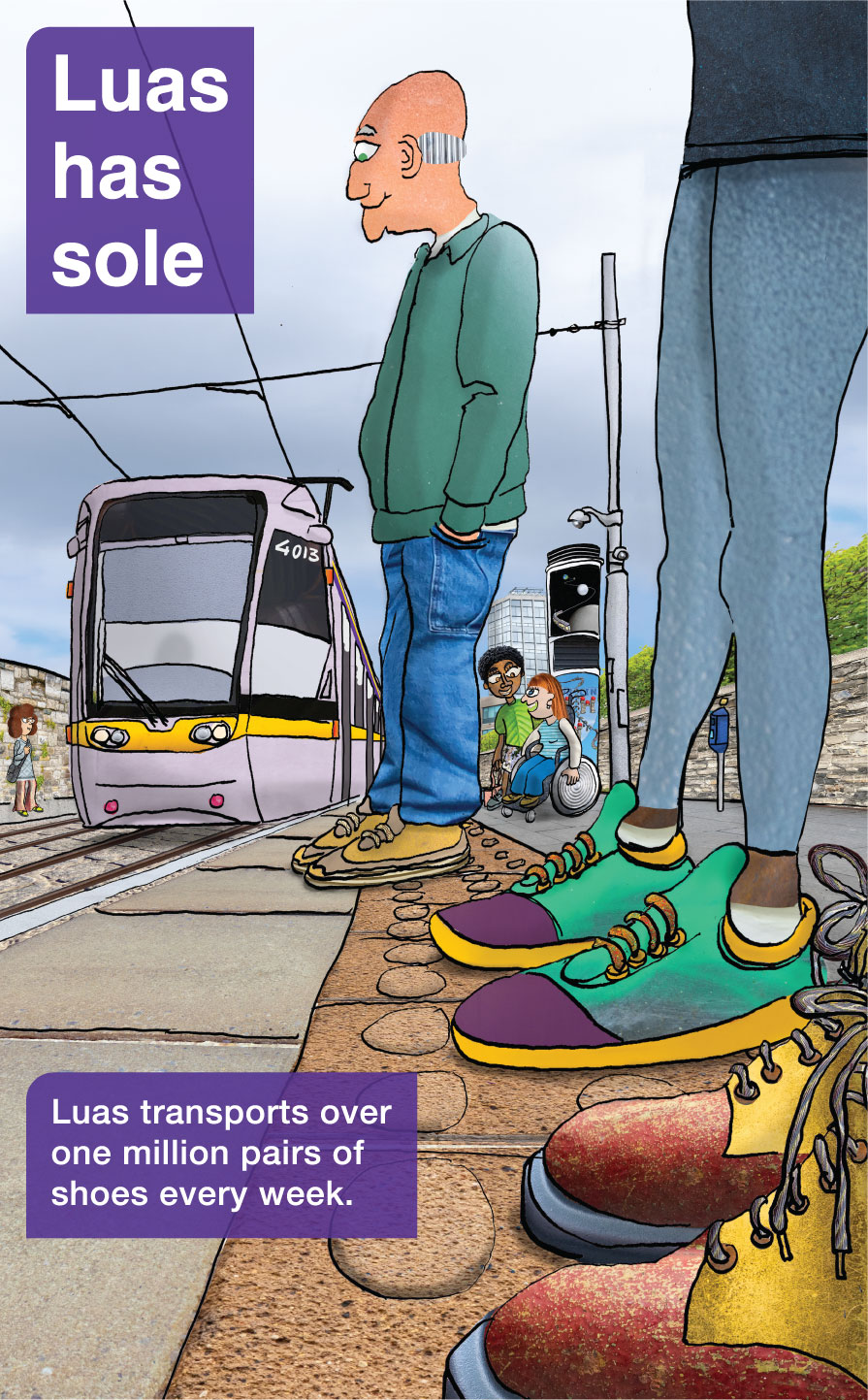
Luas has sole
Luas’ first full year in service was 2005, when it carried 22 million passengers on the Red and Green Lines combined.
Back then, the Red Line ran from Tallaght to Connolly Station, and the Green Line from St Stephen’s Green to Sandyford.
By 2011, the Red Line had been extended to include stops to The Point, and from Belgard to Saggart.
In 2010, the Green Line was extended all the way down to Brides Glen in the south. And in 2017, the Cross City extension of the Green Line was completed, taking it north over the Liffey and up to Broombridge.
New Luas lines are at the heart of the vision for Dublin and Cork. In Dublin Luas will connect Poolbeg, Lucan and Finglas with the city centre. In Cork, Luas will connect Ballincollig to Mahon Point. Some of Cork’s essential destinations lie along the route including MTU, CUH, UCC, Cork city centre, Kent Station and Páirc Uí Chaoimh.
Since Luas started, passenger numbers have grown steadily. Not just because new stops have been added, but also because Luas has become an increasingly popular way to get around Dublin.
The number of Luas passengers has grown by over 50% in the last decade, reaching 55 million in 2025. That’s roughly 10 times the population of the Republic of Ireland.
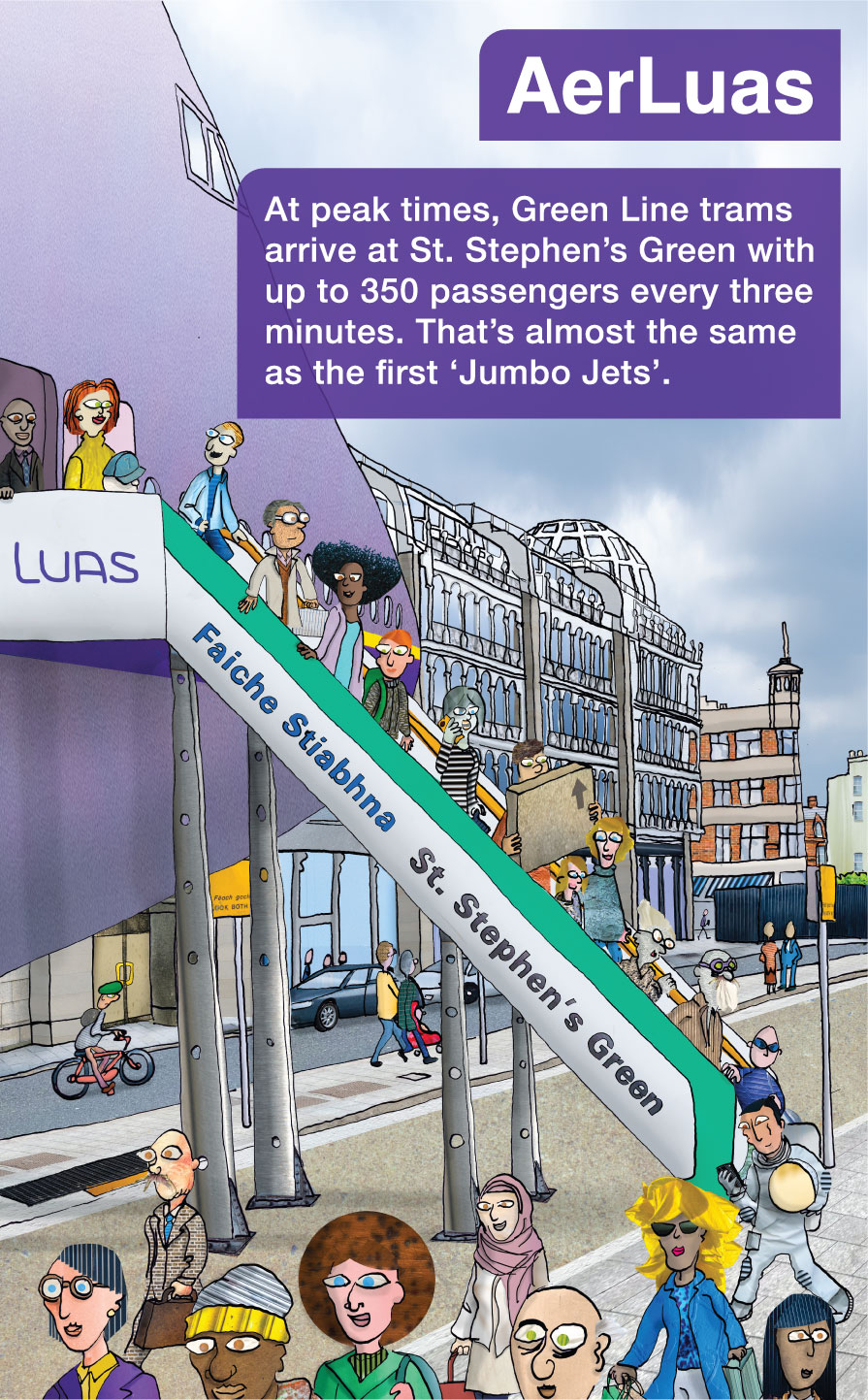
AerLuas
During morning peak times, there are 58 trams on the Luas network at any one time, carrying 18,000 passengers. That’s almost twice the capacity of Tallaght Stadium.
Around one in every seven trips on public transport in the whole of the Republic of Ireland is taken on Luas. This makes it one of the busiest public transport networks in Europe.
Luas works so hard that it carries more passengers per year than the tram system in Manchester, UK, which is double the size of Dublin, and has twice as many trams and tram stops.
If you compare all Luas stops to an airport, they handled more passengers than Rome Airport did in 2025, and that is the 8th busiest airport in Europe, four places above Dublin Airport.
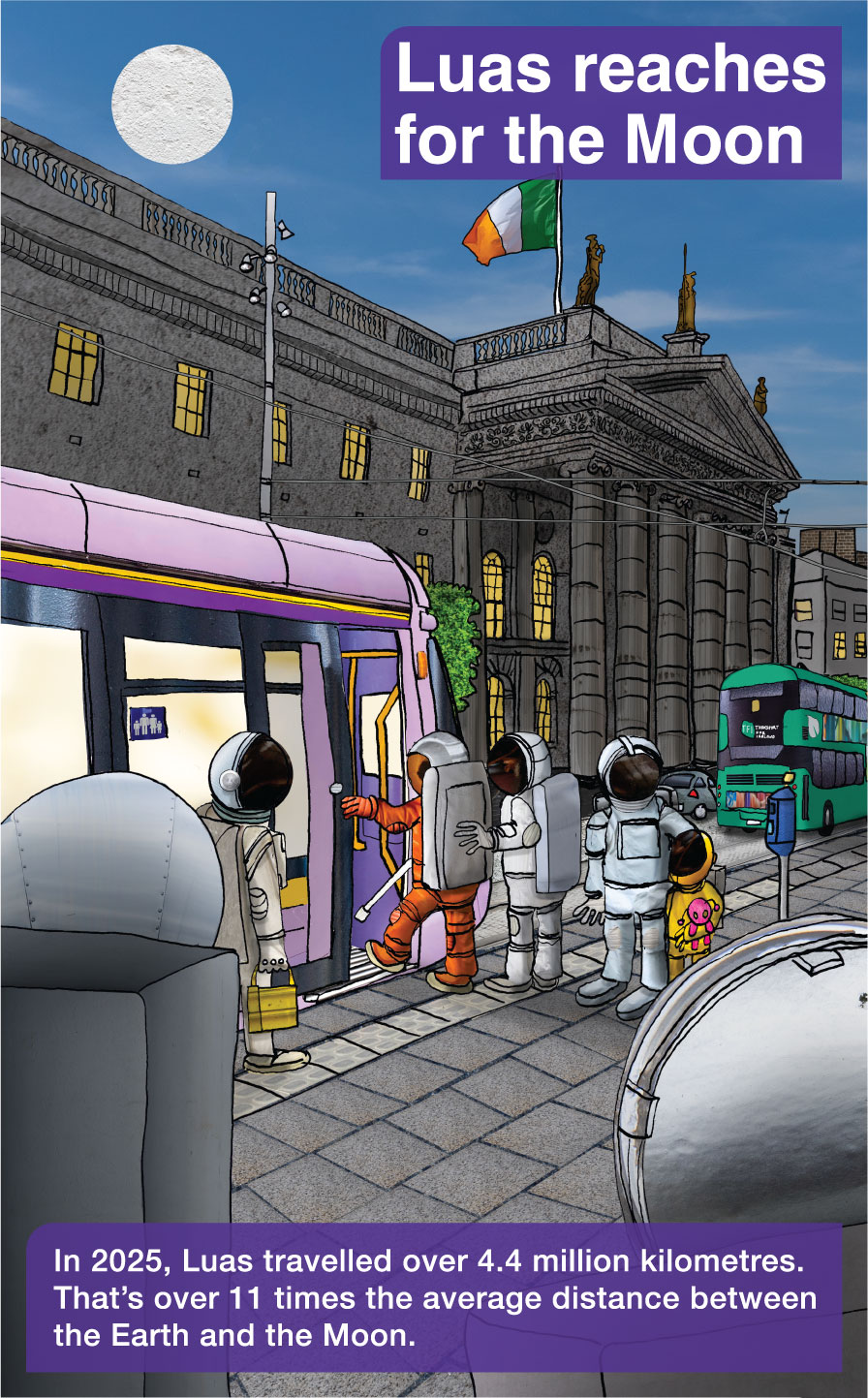
Luas reaches for the Moon
Did you know the distance between the Earth and the Moon varies because of the Moon’s elliptical orbit around the Earth?
The distance between the two can vary by over 1,000 kilometres within a single hour.
The average distance between the Earth and the Moon is 384,399 kilometres. At its furthest, the Moon is 405,696 kilometres away from us. At its closest, it is 363,105 kilometres away.
And the Moon is drifting further away from us. But only at an average rate of 4 centimetres per year.
In 2025, Luas trams covered a combined 4,415,699 kilometres. That’s around 11 times the average distance between the Earth and the Moon, or over 104 times around the Earth’s equator.
You’d have to walk up and down O’Connell Street over 4 million times to go as far.
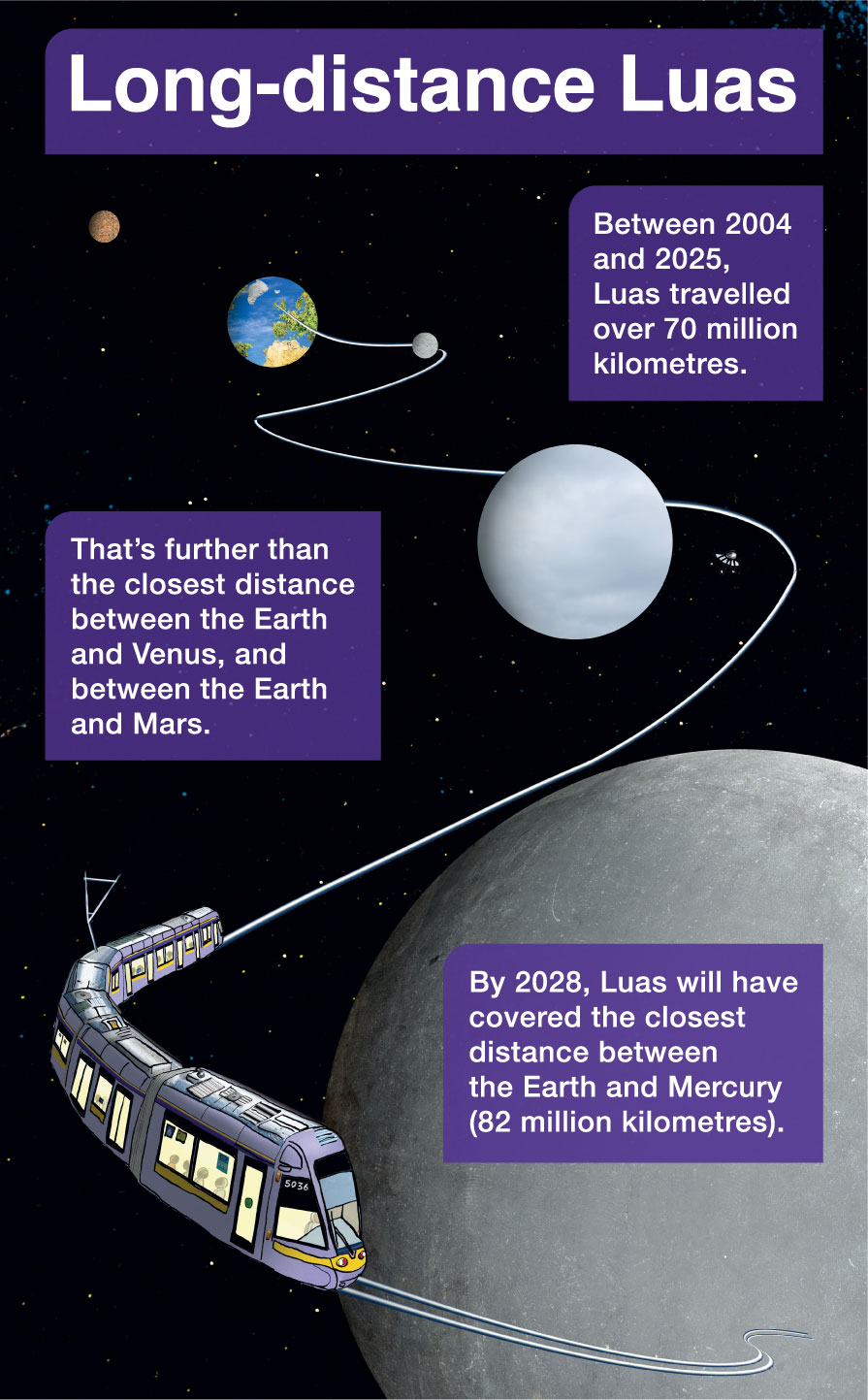
Long-distance Luas
From the start of Luas services in 2004 to the end of 2025, Luas trams covered 74,733,863 kilometres.
Last year alone, the Luas travelled over 4,415,699 kilometres.
If Luas were a spaceship, it would already have travelled beyond Venus and Mars.
At their closest, Venus is 40 million kilometres away and Mars is 56 million kilometres away. The next closest planet to Earth is Mercury, which is around 82 million kilometres away when it’s nearest to us.
So Luas will have covered the distance between the Earth and Mercury by 2028.
But we won’t get to the planets furthest away from us (Neptune and Pluto) for another 1,000 years.
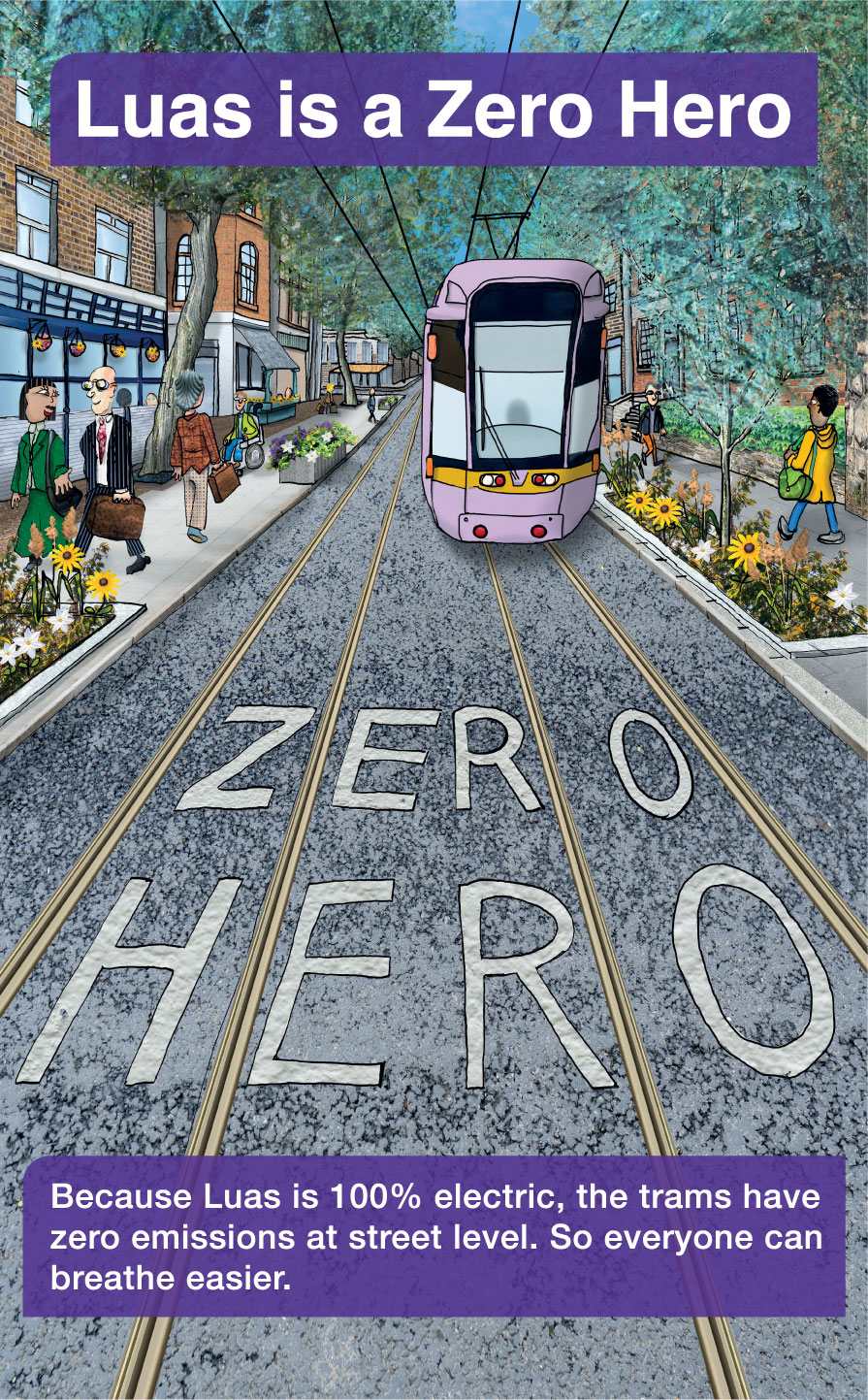
Luas is a Zero Hero
The electricity that runs Luas is generated by power stations using conventional and renewable resources.
This means that Luas itself doesn’t contribute to any emissions at street level in Dublin.
And even taking conventional power station emissions into consideration, Luas is still one of the cleanest ways overall to get around Dublin, with one of the lowest environmental impacts.
Choosing Luas is making a choice for climate and planet. If all Luas journeys were made by car, that would mean over 35,000 extra car journeys per day in Dublin. This would increased CO2 emissions by over 1,000 tonnes per month.
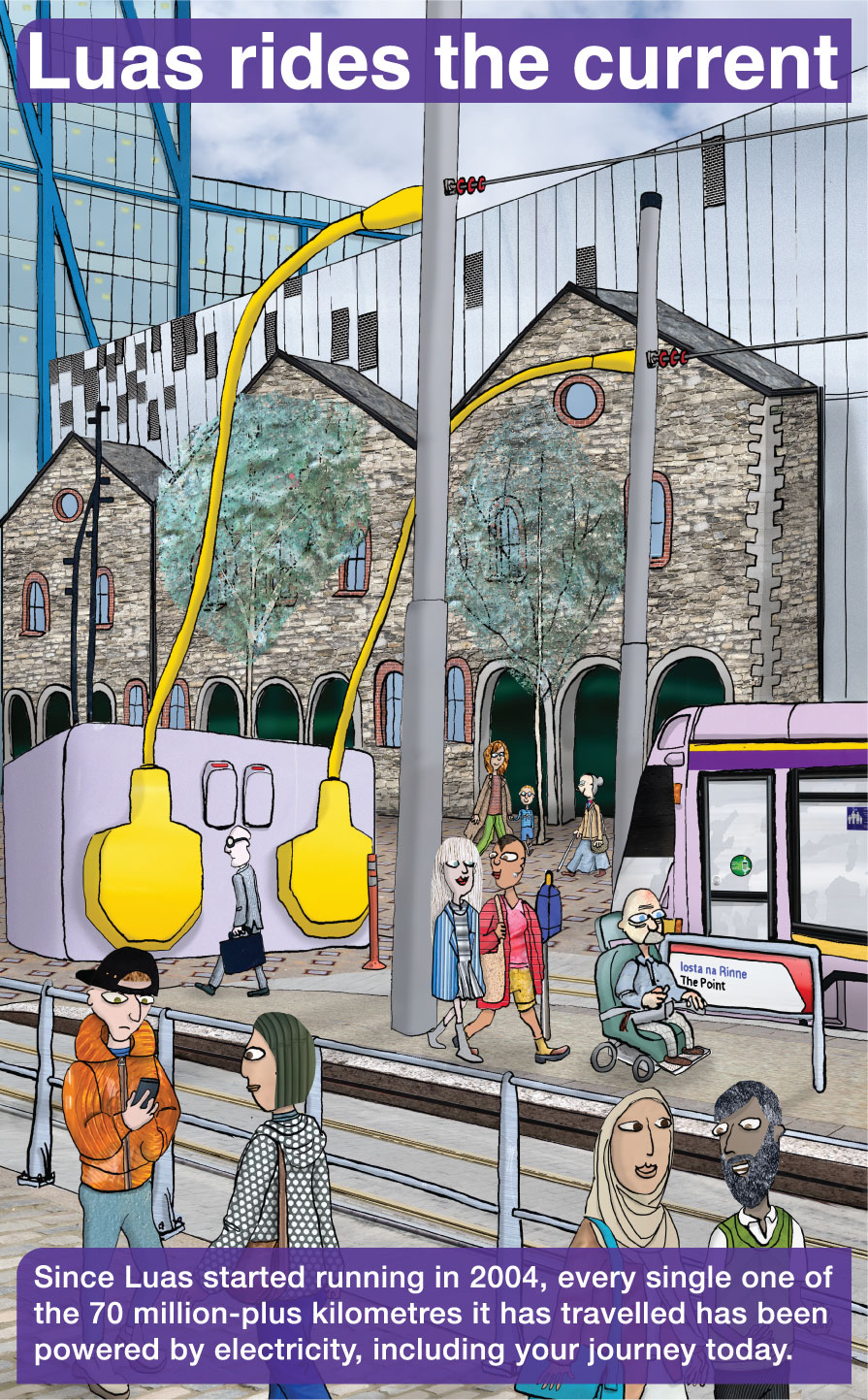
Luas rides the current
Just like your toaster, Luas runs off the national electricity grid.
But it takes a lot more to drive a tram than it does to toast a slice of bread.
Your toaster runs off a power supply of 230 volts, delivered through a standard electrical socket in the wall, but it only uses a tiny trickle of that.
A Luas tram is powered by a whopping 750 volts of electricity that run through cables six metres above the track. That’s over three times as powerful as the electricity supply to your home. Because it has always run on electricity, you could say that Luas was ahead of its time.
But Luas is much more efficient than your toaster. Every time a tram brakes, it recaptures some of that energy and feeds it back into the system – like a large generator.
Interestingly the first electric car went on sale in Ireland in 1981. (From the front, it actually looked like a mini Luas). But it wasn’t until 2010 that electric cars started to appear regularly on Irish roads.
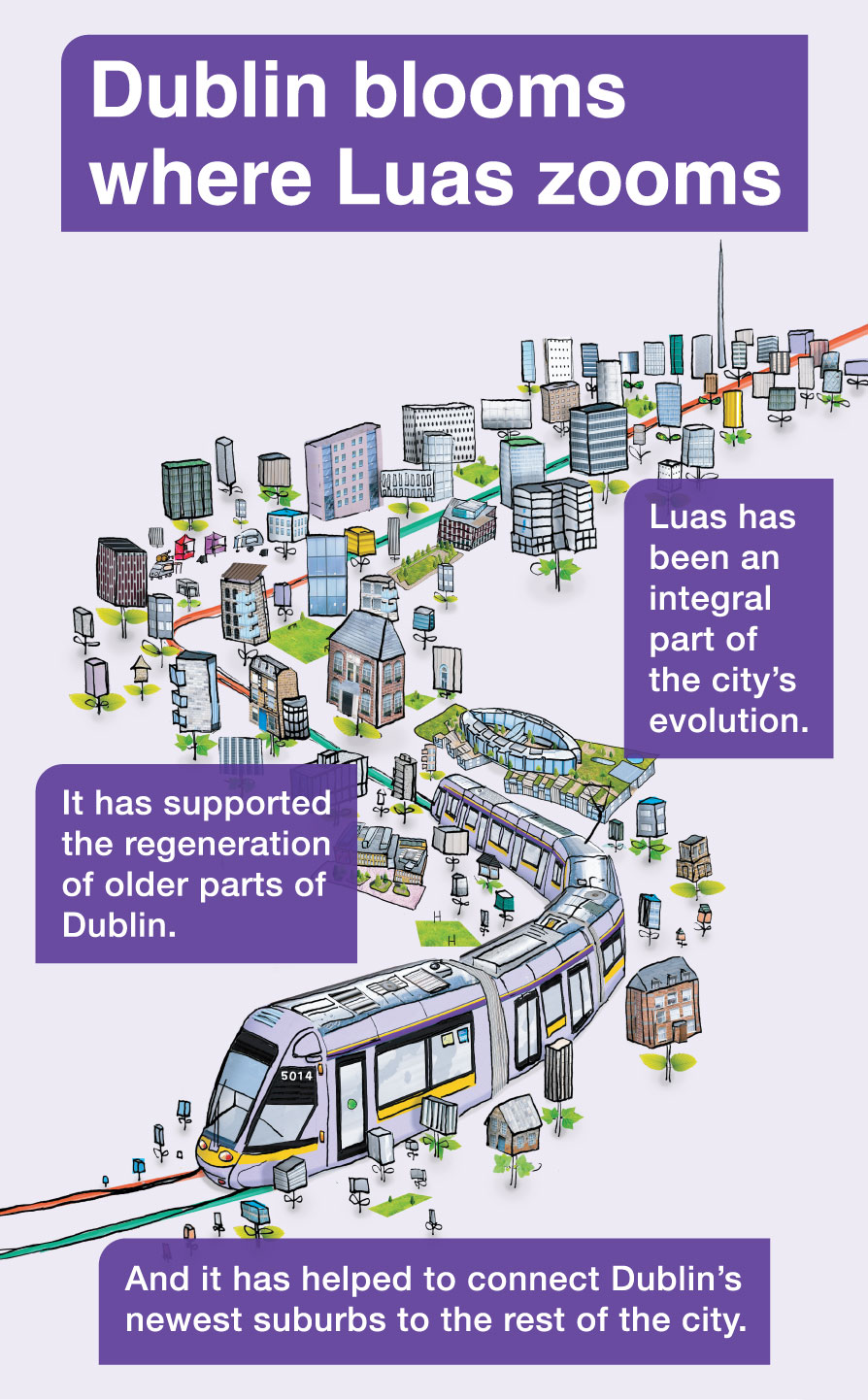
The city blooms where Luas zooms
Luas has been an integral part of the evolution of Dublin. The expansion of Luas has supported the redevelopment of older parts of Dublin. And it has helped to connect Dublin’s newest suburbs to the rest of the city.
The Red Line extension into the old Docklands has helped attract 500 businesses and 40,000 jobs into the area. It also gives the people living in the Docklands’ 1,100 new homes a convenient public transport option.
The arrival of Luas helped the regeneration of the areas around the Fatima and Rialto stops on the Red Line. Luas also gives people easy access to key hospitals here: St James’s Hospital, The Coombe Hospital and the new Children’s Hospital.
From the start, the Red Line has connected Tallaght to the rest of Dublin, but also improved transport connections with Tallaght town centre, Tallaght Hospital, the Civic Theatre and the Rua Red South Dublin Arts Centre.
The Red Line’s extension to Citywest, Fortunestown and Saggart helped stimulate housing development along the route. The Green Line has also had an impact on the city.
To the south, the Green Line’s extension to Brides Glen has helped open up the Cherrywood Strategic Development Zone. Once completed, it will be home to 25,000 people and 22,000 new jobs.
To the north, the extension of the Green Line to Broombridge provides 20,000 students and staff easy access to the new Technological University Dublin’s city centre campus at Broadstone.
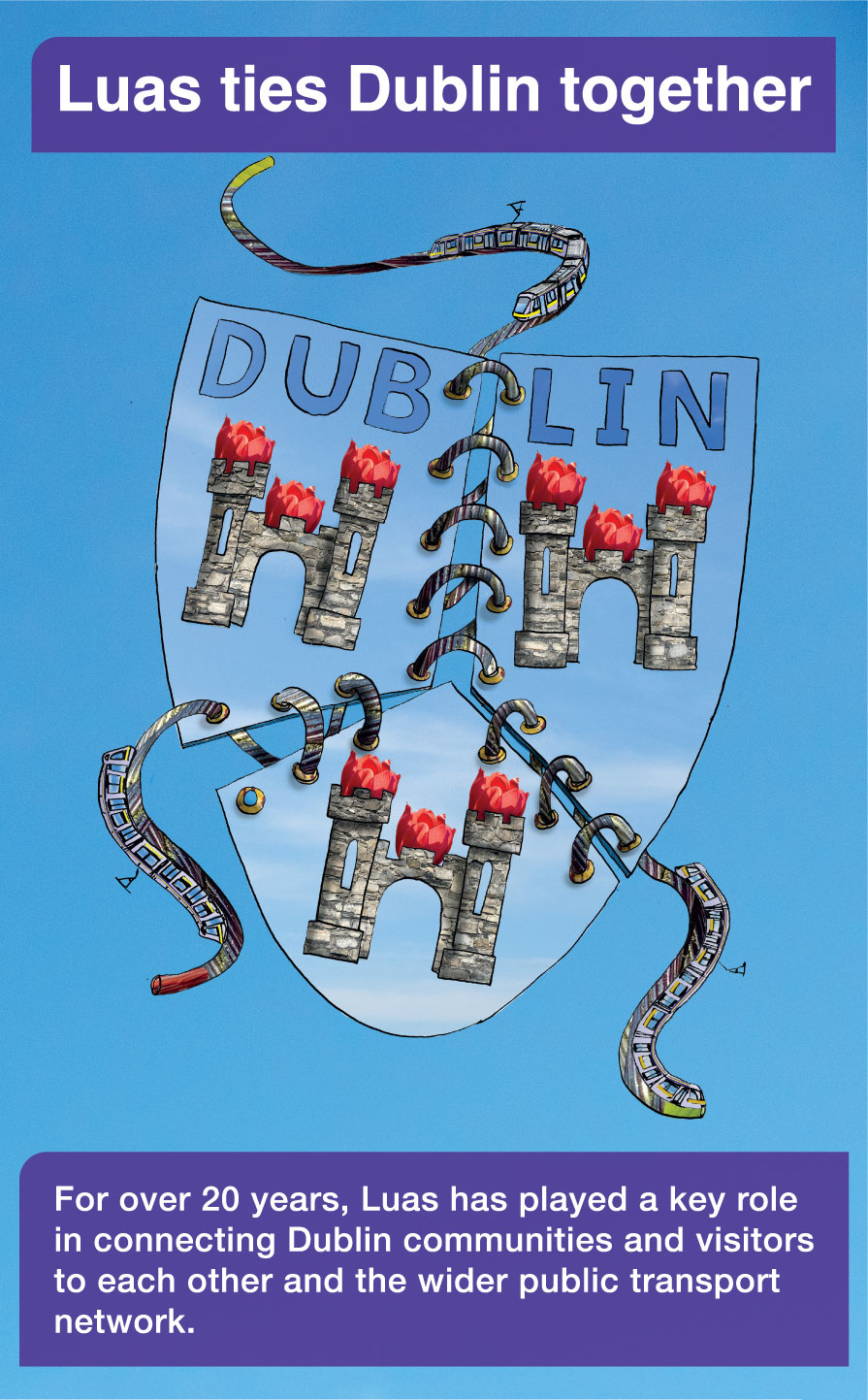
Luas ties Dublin together
Luas plays a key role in uniting every part of the city.
The Red Line runs for 20 kilometres east-west, calling at 32 stops, from The Point to Tallaght and from Connolly to Saggart.
The Green Line is 24.5 kilometres long and runs for 35 stops north-south, from Broombridge to Brides Glen.
This means that the oldest, most central parts of Dublin are connected to the newest, outer parts of the city by comfortable and convenient transport.
Not only does Luas increase the feeling that every part of Dublin is connected and belongs together, it makes the entire city more accessible to everyone. That includes visitors to Dublin from other parts of Ireland and overseas, for whom Luas acts as a trusted guide through an unfamiliar city.
Apart from helping to make Dublin a community, Luas is itself a community – one that’s based on a shared experience. After all, travelling on Luas is something people do together over 55 million times every year.
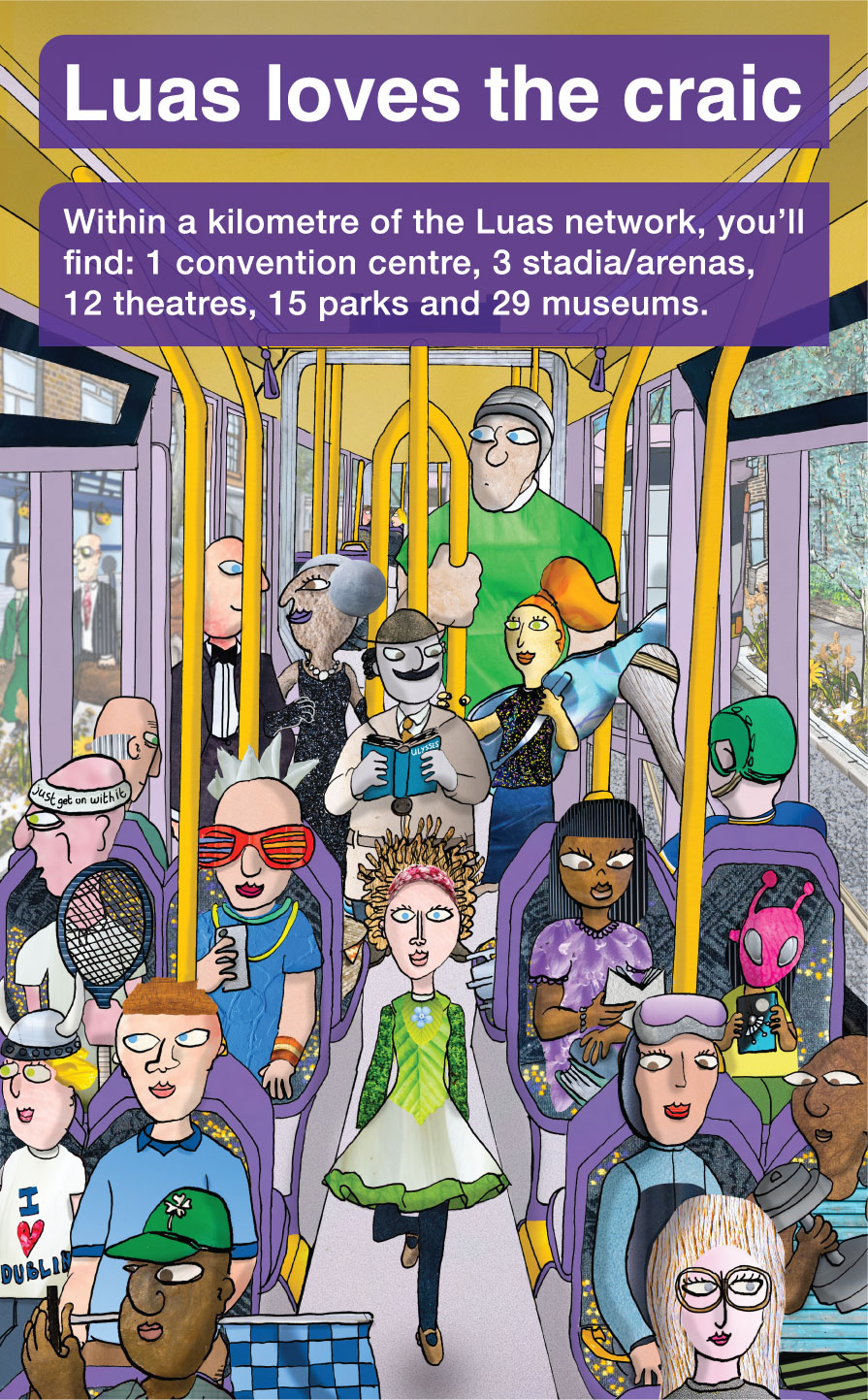
Luas loves the craic
Luas has become an important way for people to get to Dublin’s recreational centres.
Within 1 kilometre of Luas network, you’ll find:
1 convention centre
3 stadia/arenas
12 theatres
15 parks
29 museums
Luas will take you within walking distance of Tallaght Stadium and Croke Park.
Luas drops you just around the corner from the Convention Centre Dublin and bring concert goers right down to The Point. And helps you get home afterwards.
The 12 theatres served by Luas include the Gaiety, the Academy, the Abbey, the Bord Gáis Energy Theatre and the Olympia.
Parks near a Luas stop include St Stephen’s Green, Merrion Square, Phoenix Park, Iveagh Gardens and Tolka Valley Park.
The museums include the National Museum of Ireland, the National Gallery of Ireland and Kilmainham Gaol Museum.
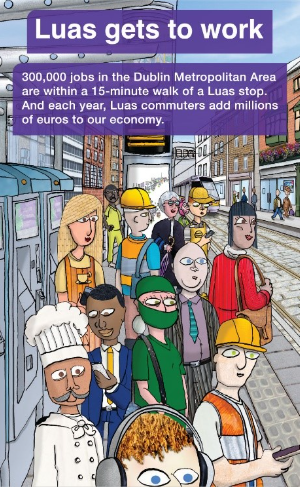
Luas gets to work
Investing in high-capacity public transport has transformed where businesses locate and where people work, with a strong employment growth along Luas corridors.
Over 800,000 people are now employed in Dublin. 300,000 of those jobs are within a
15-minute walk of a Luas stop.
And Dublin’s workers are making more and more use of the convenience Luas offers. Between 2011 and 2022, there was a 35% increase in commuters using Luas to get to and from work.
In addition, there are no fewer than 111 primary and 47 secondary schools within
1 kilometre of Luas. There are also 31 third-level colleges and universities, including Trinity College, Technological University Dublin and Dublin Business School.
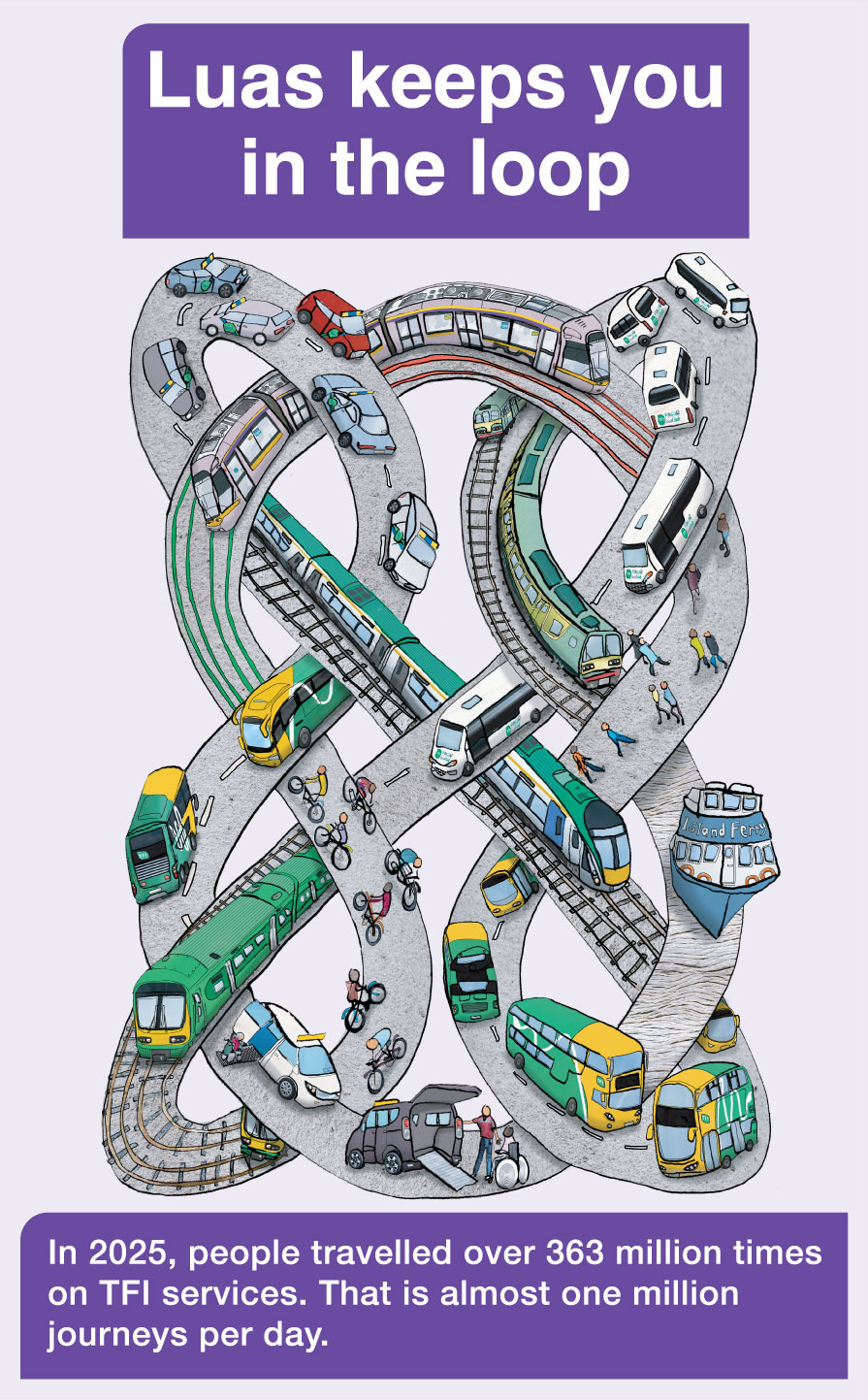
Luas keeps you in the loop
Public transport services operated by Transport for Ireland (TFI) play a major role in Irish life. Together Bus Éireann, Dublin Bus, Go Ahead, Iarnród Éireann, Luas and TFI Local Link got 363.5 million passengers to their destinations in 2025.
That was an increase of 6%, almost 20 million journeys, over the 343.6 million completed in 2024.
For TFI Luas, 2025 was a record year. It carried over 55 million passengers, up from 52 million in 2024. Dublin Bus carried 164 million passengers in 2025. Bus Éireann carried 53.6 million passengers. Go-Ahead Ireland services were used 26 million times.
Local and regional services also grew. TFI Local Link services carried a total of 6.97 million passengers. These include regular route services and demand responsive transport (TRT). This was a record year for TFI Local Link, with a 19% increase compared with 2025.
This growth builds on the continued expansion of TFI’s Rural Mobility Plan. This plan aims to improve transport and mobility in more remote parts of the country.
Sources: Transport Infrastructure Ireland: 20 Years of Luas – the Benefits of Luas

